
I hear this a fair bit: someone's done a dodgy or ropey repair, and no way would whoever came after do that. In a good many cases, that's fair comment, but for some... not so much. I'll let others judge the validity of this one.
So my fridge freezer started leaking, and it's an F&P thing made in China, so Haier in a fancy dress, but it is a four-door machine with ice and water. It's not unusual for a machine like that to spring a leak for one reason or another.
After a bit of digging online, I found a fairly common fault with what they call the Water Filter Head, which, as you can see from the link, ain't cheap. And all it is is a plastic filter holder thingybob and a couple of hoses, not exactly rocket science. But the "head" part of it, which you probably could get he hoses out of if you really tried hard enough (I didn't; side cutters did that) has a tendency to leak.
Under it, there's a small channel that the water goes into or is supposed to); then it runs out a drain to the tray under the condenser to evaporate naturally. But there was too much leaking, so I got water in the fridge.
At first I thought it was a pressure problem, as the pressure here did rise recently, so I assumed that's all it was; I turned down the pressure and there was no change. That was when I started really looking.
I was about to order and pay for the new water head thingy when it struck me: we're in a very soft water area with great water quality that doesn't really need filtering, so why do it?
And when I was bogging about with the pressure, I found a couple of old water line kits (don't ask) I had kicking about, and that's when the thought struck me: rather than pay, or even trade for, an £ 80-odd part, why not just bypass the filter out totally. It made sense, as the filter, an HRWF one, ain't a cheap thing, so this notion made sense.
If I want to add a filter, I can easily. I'd just add an inline one (this one to be exact as it's cheap and works very well) that's a fraction of the cost of the pukka HRWF one, even a copy one.
I am quite sure that many, if not mostly all, machines that use this filter will have a similar issue, and you can cure it like this. If you want to of course.
With all this in mind, I set to work.
By Passing the Internal Water Filter
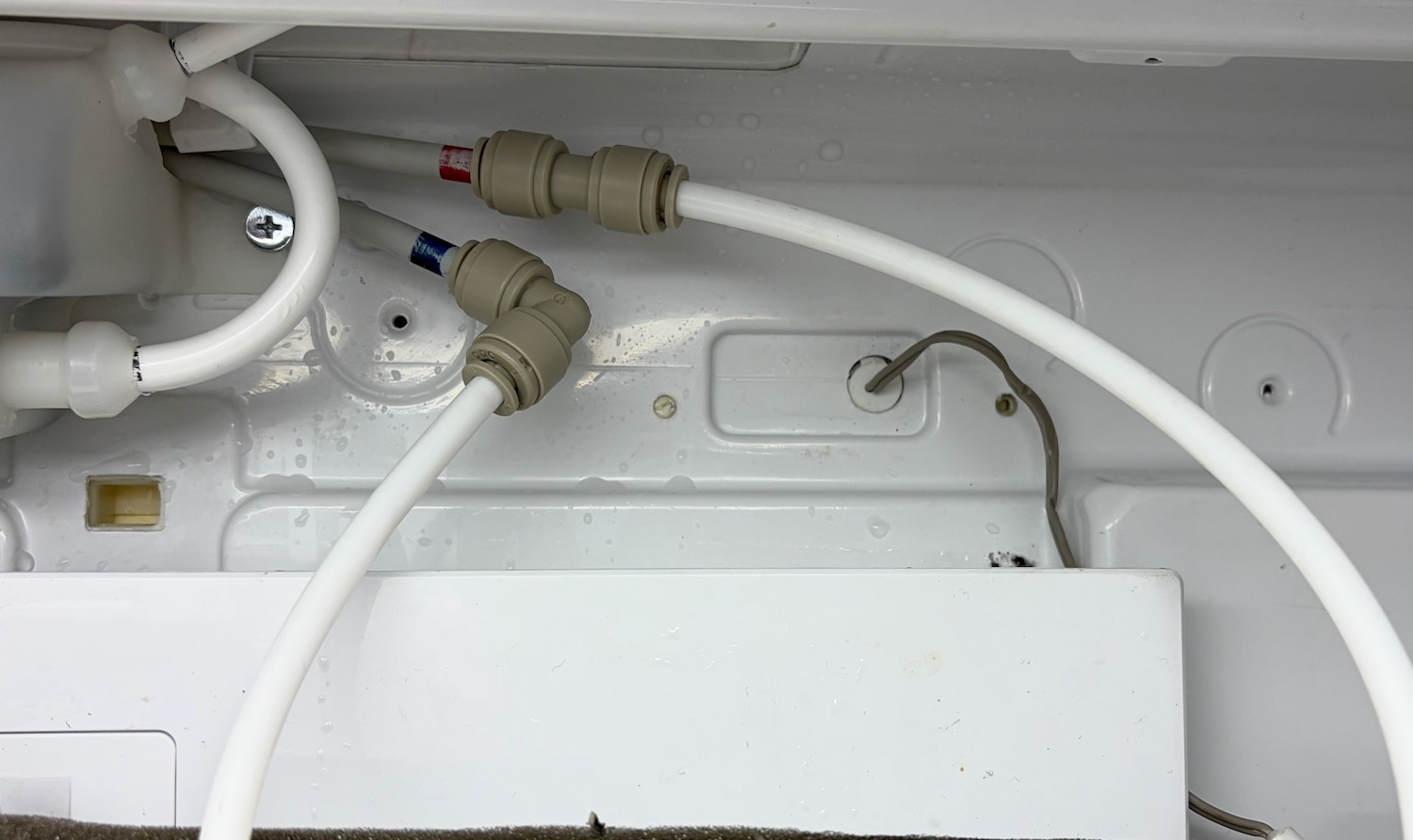
Here's what it involved; I added handy dandy arrows so I can explain, and most people will understand.
I only had one 90˚ and one180˚ connectors the correct size, hence the bodginess but heh, it works.
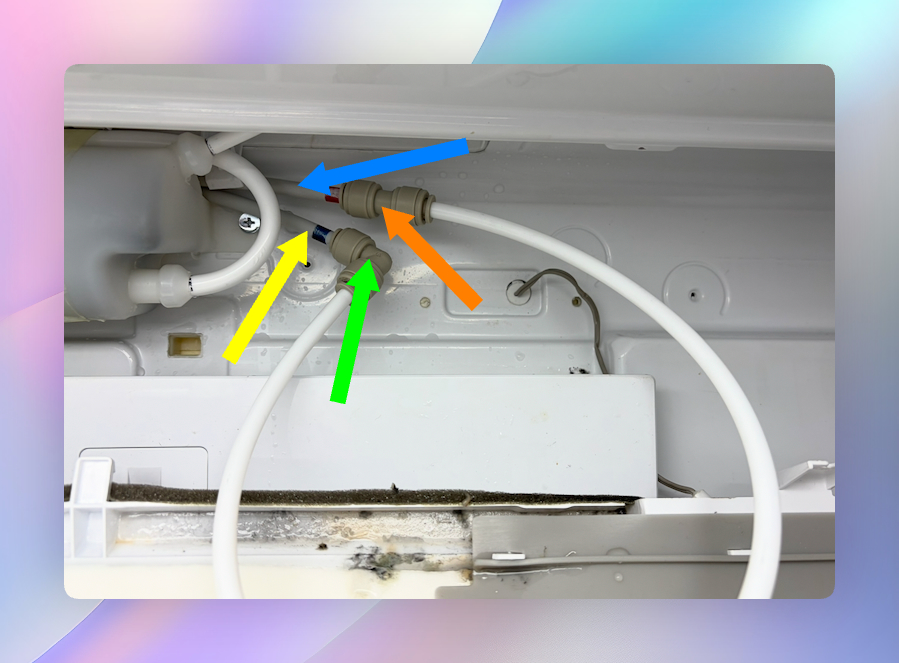
The blue arrow I believe, is water in; yellow, water out (my bad as that's red and blue respectively on the actual hoses) and all I did was get a bit of the semi-rigid water line pipe and loop those together using the push-fit connectors.
Then I tucked the hose in, making sure not to kink it, since that'd be bad, and that's why there's a fair amount there: to let it loop gently and not kink. Put the housing cover back on, as well as the temp sensor you can see dangling around, after ensuring there were no leaks, and job done.
Start to finish, 15-20 minutes. Including clearing the shelves and whatnot to get into it.
The actual filter head looks like this after I cut it off:
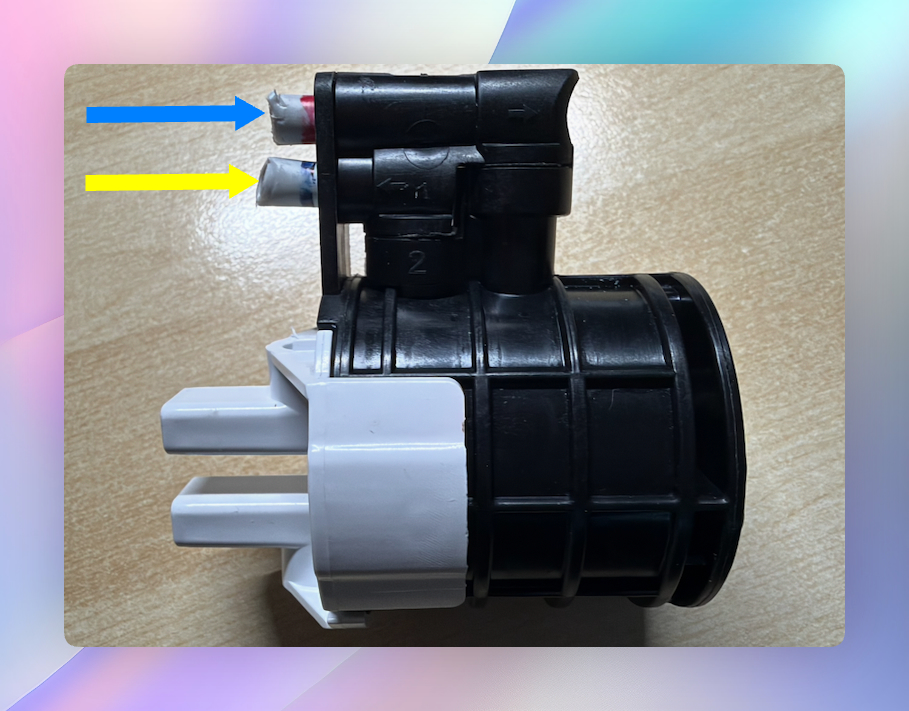
Just for the sake of it, the arrows are there to show where the hoses originally went. And you can see where I ut the head off, as close as I could.
That head part just clips out of the housing; it's a snap-fit affair, and it always struck me as a bit iffy the way it was set up. I just didn't like it; no clue at the time if it was going to be a problem, but it turns out that it was for me and many others as well.
And inside the head, it's hard to see, but it does look a bit dodgy with detritus in it:
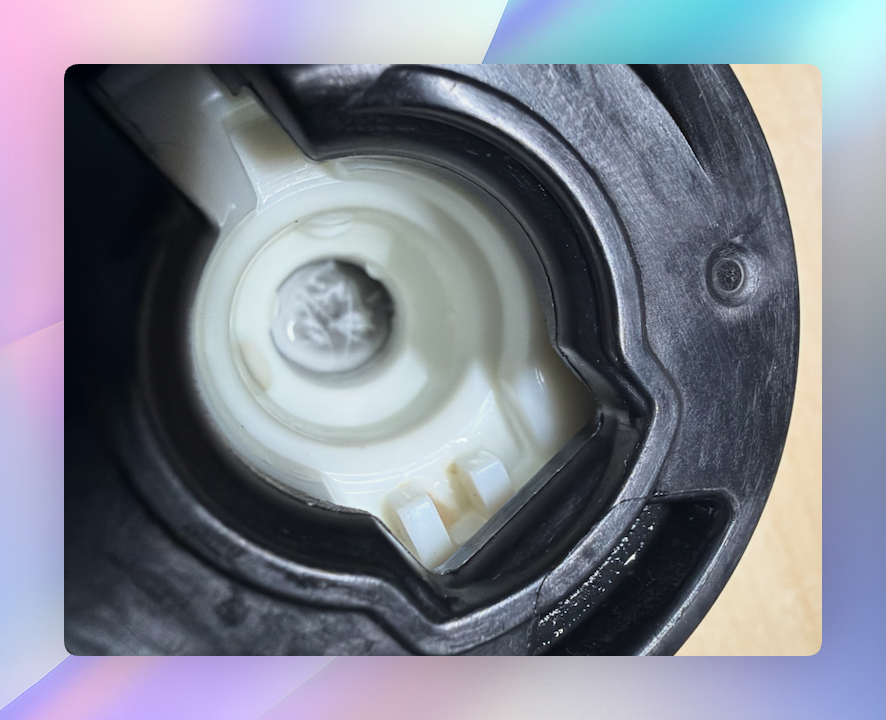
I dont'rate the design, but that's just me; what do I know?
Dodgy Or Genius?
This all led me to think: is this a dodgy repair job or a genius one?
On the one hand, an "approved" F&P or whatever tech sees that, and they may well have a fit and extol the virtues of pukka repairs, parts and how dodgy this bodged-up cowboy repair is.
But I don't care, and I suspect most owners wouldn't either, as all I wanted was a working fridge freezer that didn't dump water all over the floor.
For non-approved repairers, sure, they'd mostly all try to do the job "right", but if you're in a hole, need to fix it and get the customer up and running, any means necessary, right?
I'm not saying that this is right; I'm not saying that people should do this (to avoid a pricey part and filters), but what I will say is that it works.
In the end, for a repairer, making it work is the goal. How that's done can vary.