
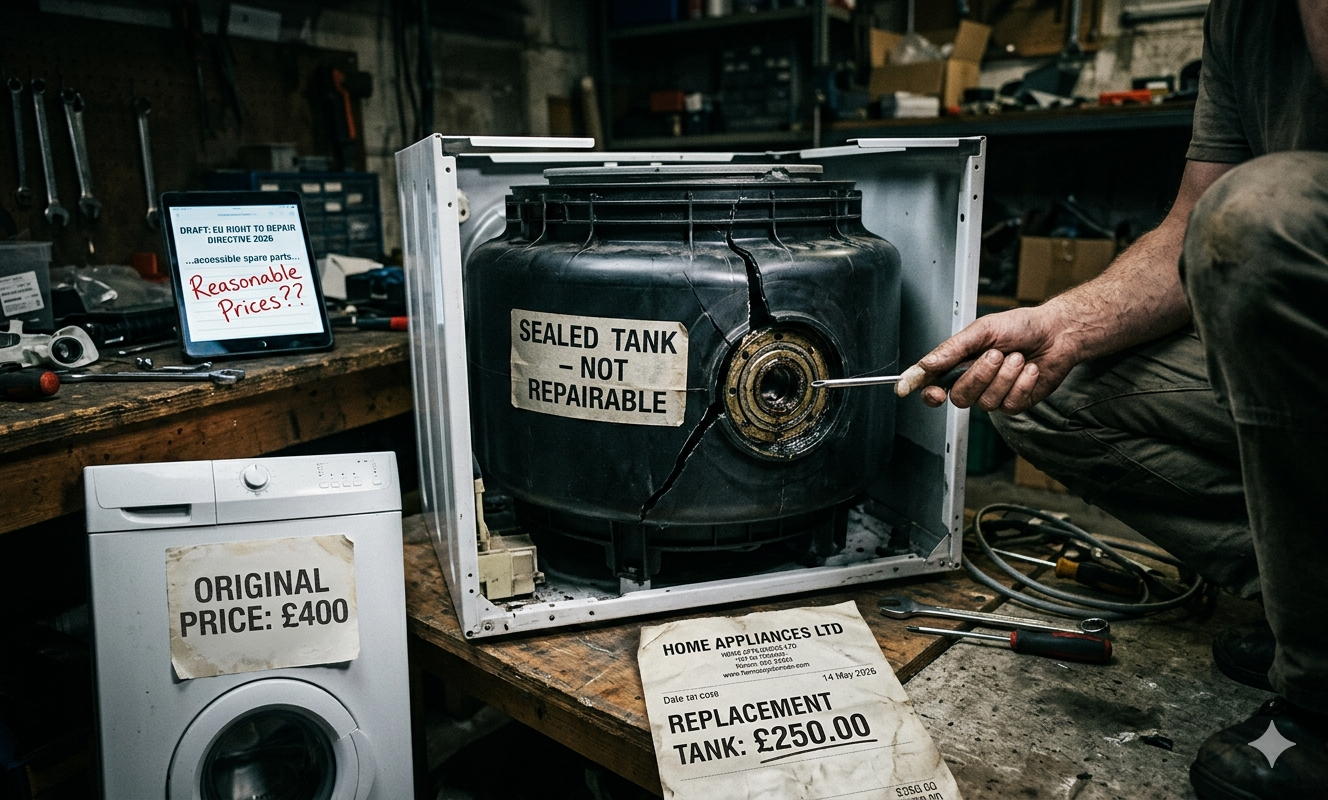
Sealed tanks, ‘reasonable’ spare parts that cost 80% of a new machine, and weak legislation with no enforcement. Despite years of promises and a 2026 EU directive, appliance makers are still blocking real repair rights. Here’s why consumers are being ripped off—and why nothing has actually changed.
For those who haven’t been following this topic over the past decade or so, Right To Repair (R2R) seems to have come a long way, albeit a seemingly torturous and slow way.
For the appliance industry, it’s a vital move towards sustainability, and its importance cannot be understated.
But, it would appear that there is resistance to it from manufacturers who appear, unsurprisingly, more interested in selling more and more, not supporting products that are already in the field. Or to be more kind to makers, they perhaps don’t see any benefit in adopting the spirit of R2R and more so if there is a potential cost in them doing so.
It is very possibly not a malicious thing, just one borne of financial reality.
And, the legislation, despite all the fanfare in the press about customers gaining the right of repair, is too weak (in many people’s opinion) and thus far untested and unenforced. On paper, consumers have more rights than ever, but in practice, is that the case?
Repairable Design & Spare Parts
In our world, right now, repairable design and spare parts are supposed to be available for washing machines, tumble dryers, dishwashers, and fridges under the Ecodesign Regulations.
And yet, we constantly (daily) see washing machines with sealed tanks that cannot be repaired, tumble dryers with refrigerant systems that cannot be repaired, dishwashers with heat pumps and non-replaceable parts, fridges with embedded sensors and such that cannot be replaced or, if they can not at all easily.
These products are on sale in stores now. Despite legislation that, in spirit if not in actuality, should make these products, if not illegal in the EU, at least see the makers having their knuckles rapped for it.
And yet…. Nothing.
Just to look at one example: the sealed washing machine tank. It’s somewhat ironic that the largest perpetrators of this practice are European brand names (and Turkish). Virtually all the large European companies that bemoan the influx of Asian competition are the ones that led the charge of this kind of practice. To save money, we must assume.
On the ground, it doesn’t look like this legislation is really having much of an impact.
And that’s not looking likely to change anytime soon.
As for spare parts, they were available anyway; makers have had little or nothing to do there as there doesn’t appear to be a time frame for how long parts have to be available for. Meaning, this is a bit of a damp squib in reality.
After a few years, depending on the initial purchase price, people will all too often accept that they have to scrap a machine for the sake of a few pounds’ worth of parts and just move on. The vast bulk of those people won’t even complain about it as they don’t know who to complain to or if it would mean anything. You might see the odd bad review, but that’s about it.
Most large companies can just ignore it.
Right To Repair Directive
This comes into force in July of 2026 and means that makers have to offer “reasonable spare part prices”, “repairs” and not to have “software blocks” along with some other bits and bobs.
Looking at the easy ones to cover off first, they all offer repairs. Well, virtually all do, there are a few outliers that appear not to but those are rare, often generic re-branded stuff sold on Amazon, eBay and such platforms. Low volume and cheap, I’ll say, not great products.
This is limited, however, to OEM repairs. It does not have any bearing on independent repairs nor offer any guarantee of them.
Software blocks etc, to stop people from replacing a part without it having to be paired or whatever, isn’t really a big issue as most Whitegoods makers don’t do that. Miele perhaps and a few others do to some extent but it’s not a huge issue in my view.
Reasonable parts prices, well, there’s a whole can of worms!
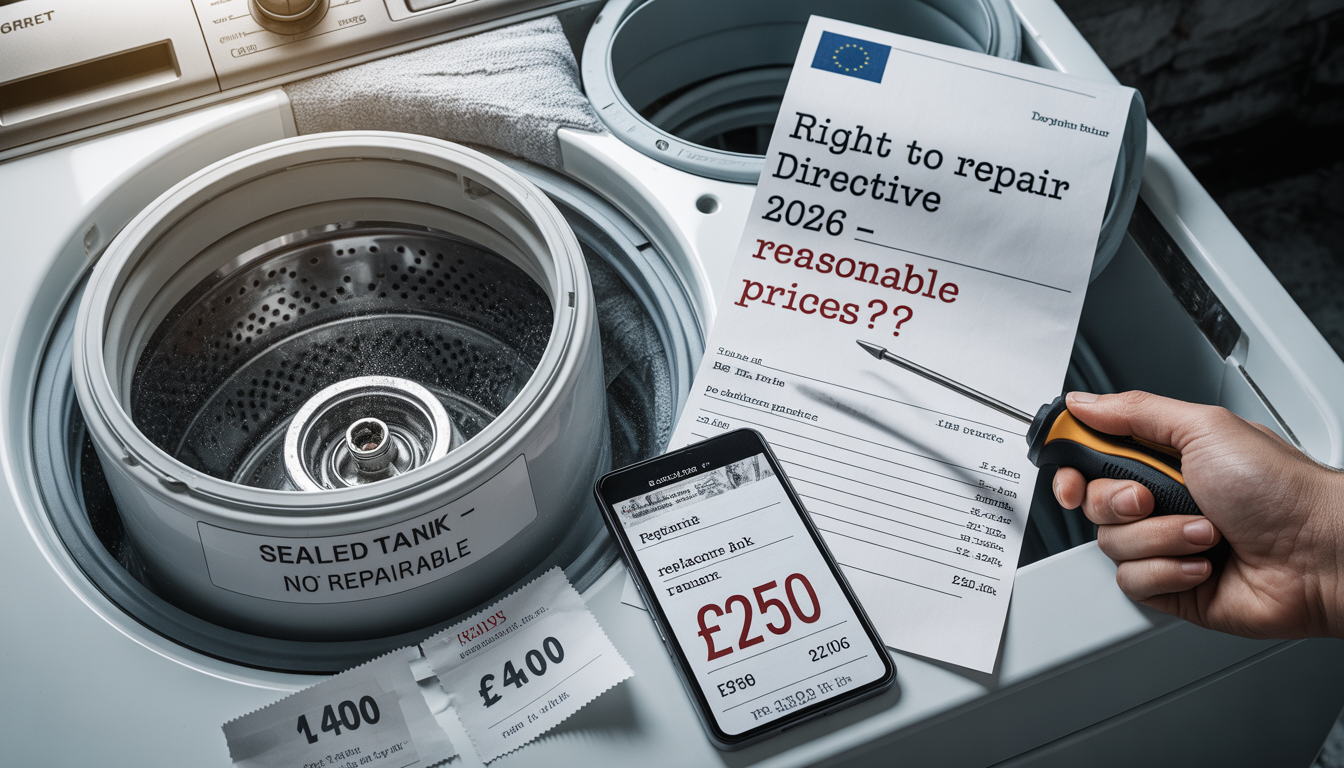
Reasonable Spare Parts Prices
What’s reasonable?
That’s the single, two-word question that blows this notion up. Who defines what’s reasonable or what’s reasonable for what?
It’s far too undefined to really have any teeth. Much of the current UK consumer legislation has a lot of “reasonable” in there as well, and I’ve dealt with that a lot over the years, both in retail and for brands.
I mean, jumping back to the sealed tank thing for an example, what’s a “reasonable” price for a complete tank unit?
Let’s say it was failed bearings that necessitated the replacement. Bearings cost about £30, but a new tank is £250… is £250 a reasonable ask, on a £300 machine or even a £400 one?
Most people would say that wasn’t “reasonable”, and I’d agree. All the more so when you consider the initial cost of the machine, how can one component constitute more than 50% of the RRP, let alone more than 80-95% of it?
Which is why I’ve argued for some time that there should be a percentage limit on the cost of parts, as in no one component can cost more than X% of the initial RRP.
Without any guidance on what a part can cost, the notion of “reasonable” lies in the eye of the beholder, as it were, and no doubt makers will not have the same view as consumers. It really is too flaky to have any real “teeth”.
Unless someone takes it to court, of course, and we get more definition.
I think that, across all of the EU, someone probably will take it to court or, it’ll get funded to take to court and get some sort of precedent and, it doesn’t have to be a washing machine part, almost any will set the bar.
It’s what the Americans call a “crap shoot” though on how long that might take and what way it’ll go.
However, if a court decides (as they often do) that “reasonable” is more in line with consumer expectations rather than any manufacturer’s ones, it could be extremely interesting.
It is also interesting that many manufacturers seem to be just carrying on as normal, as we’ve seen no real change despite this legislation coming into force in a few months’ time.
Public Awareness
This is where the R2R campaign by Right To Repair, UK Whitegoods, Whitegoods Trade Association, Louis Rossmann and others seems to be starting to get some traction.
People are aware. And, becoming more aware.
People are having it highlighted just how manufacturers and, I am not just talking about the white goods industry, are being ripped off, lied to, sold junk and prevented from repairing their own goods, they paid for.
In some instances, we can see makers actively preventing repairs, forcing replacement and all kinds of dirty tricks leading to many calling it for being, as they see it, planned obsolescence. Whether this is actually the case or not isn’t really all that relevant in the arena of public opinion, what is important is blistering reviews and comments saying that X, Y or Z brands are toxic due to this kind of behaviour.
If you’re Apple or Google where consumers don’t have a lot of choice, you might get away with it. That is, if the mainstream media doesn’t gut you for a practice that consumers won’t stand for, then your share price takes a beating… at least for a while.
For smaller brands, it could be deadly to be tarnished with being, “that brand that rips off customers”.
Repairers
For independent repairers all this, for now, probably doesn’t mean that much and is unlikely to have much of an impact. Other than makers being forced to offer repairs, maybe.
In time, it may necessitate makers lowering parts prices, making repair a more viable option but for the time being, given we don’t see much change, that’s not very likely.
Although its the current squeeze on the cost of living worldwide (not helped by unnecessary war) it is possible that enough people get hacked off with having to replace rather than repair that the voices calling for a fairer shake here may get ever louder. Only increasing awareness of R2R and, awareness of companies that don’t offer that fair shake.